

Guy Ritchie’s The Gentlemen, released in 2019, represents a fascinating return to the director’s roots while simultaneously redefining the modern British gangster film. Known for his early works such as Lock, Stock and Two Smoking Barrels and Snatch, Ritchie’s signature style—fast-paced dialogue, intertwining narratives, and sharply drawn characters—has long defined his cinematic identity. Yet, in The Gentlemen, Ritchie doesn’t just replicate past formulas; he refines and elevates them, creating a film that feels both nostalgically familiar and excitingly contemporary.
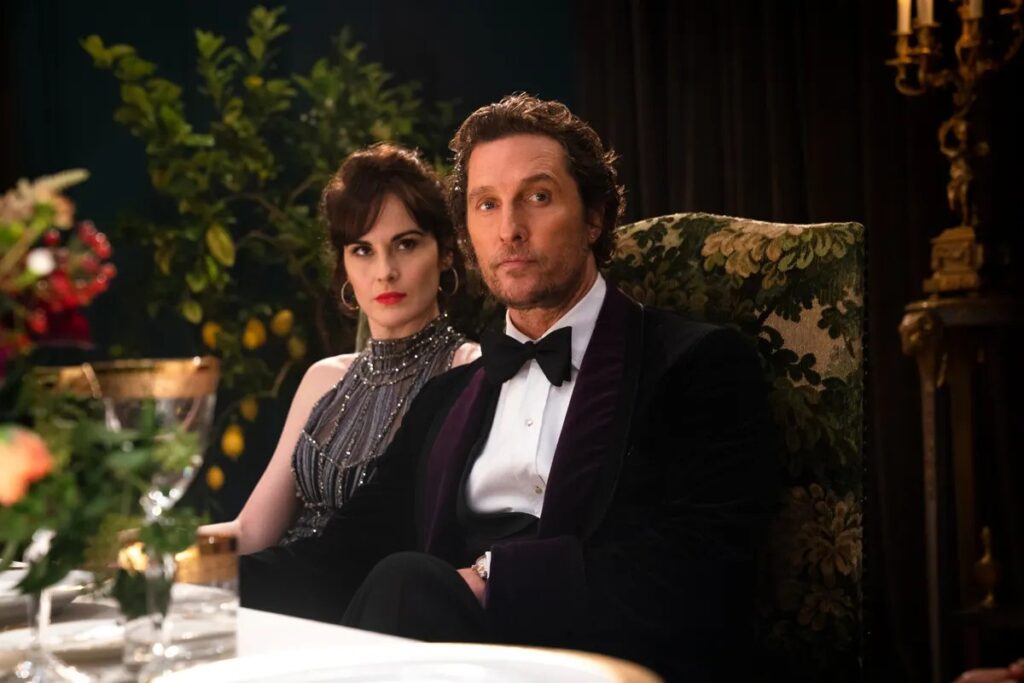
At its core, The Gentlemen is a story of ambition, power, and deception in London’s criminal underworld. The film follows Mickey Pearson, played with effortless charm by Matthew McConaughey, an American expatriate who has built a lucrative marijuana empire in the UK. When he considers selling his business, the ripple effects expose the fragile alliances and cutthroat rivalries that define the city’s criminal elite. What makes The Gentlemen exceptional is how Ritchie weaves humor, class commentary, and cinematic elegance into what could otherwise be a standard crime caper.
A Return to Ritchie’s Signature Style
For viewers familiar with Ritchie’s earlier work, The Gentlemen feels like a reunion. The rapid-fire dialogue, stylized violence, and ensemble cast of eccentric yet compelling characters all echo the director’s signature aesthetic. However, Ritchie approaches these elements with a maturity that distinguishes this film from his 1990s crime comedies. Whereas Lock, Stock and Two Smoking Barrels thrived on chaotic energy and youthful irreverence, The Gentlemen exudes confidence and control, allowing the characters and plot to breathe even amid elaborate action sequences.
The film’s dialogue is particularly noteworthy. Ritchie has always been praised for his ear for speech, and in The Gentlemen, it’s clear that he understands the rhythm of words as much as the rhythm of bullets. Characters like Raymond, played by Charlie Hunnam, and Dry Eye, portrayed by Henry Golding, deliver lines with a precision and wit that both amuse and build tension. The conversations are not mere exposition; they are tools of manipulation, strategy, and storytelling, revealing character motives while keeping the audience engaged in a cerebral cat-and-mouse game.
Reinventing the British Gangster Archetype
British gangster films have long been associated with gritty realism, moral ambiguity, and social critique. Think of classics like Get Carter or Layer Cake, where the criminal underworld is depicted as a reflection of societal structures and the fragility of human ambition. The Gentlemen honors these traditions but reinvents them for a modern audience. Instead of focusing solely on the dark and brutal aspects of crime, Ritchie infuses the story with style, humor, and sophistication, making the criminal world feel like a high-stakes chessboard rather than a bleak battlefield.
Mickey Pearson himself is a departure from typical gangster protagonists. He is charming, articulate, and meticulously strategic, more akin to a corporate mogul than a street-level thug. This positioning elevates the narrative from a simple crime story to an exploration of power, influence, and social mobility. Pearson’s empire is built on intelligence, negotiation, and calculated risk rather than sheer force, reflecting a shift in how modern cinema depicts organized crime. Ritchie’s choice to center the film on a character who embodies elegance, intellect, and control redefines what it means to be a “gangster” in contemporary British cinema.
Layered Storytelling and Narrative Complexity
One of the most striking aspects of The Gentlemen is its layered storytelling. The narrative unfolds through multiple perspectives, unreliable narrators, and strategic reveals, demanding that the audience actively engage with the plot. This technique not only heightens suspense but also allows Ritchie to explore themes of loyalty, betrayal, and moral ambiguity in a nuanced manner. The film’s structure recalls Ritchie’s earlier work, yet it is far more sophisticated, balancing complexity with clarity so that viewers are never lost in the narrative labyrinth.
The use of narration by different characters adds depth to the story. Each narrator presents their version of events, revealing both their biases and motivations. This multiplicity of perspectives makes the audience question what is true and what is performance, underscoring the film’s exploration of deception and perception. By weaving this narrative complexity into a stylish, action-packed framework, Ritchie proves that gangster films can be both intellectually stimulating and viscerally entertaining.

Humor and Charm Amidst Violence
Violence is a staple of the gangster genre, yet The Gentlemen handles it with a distinct flair. The film juxtaposes brutality with humor, creating moments that are thrilling, tense, and often hilarious. Ritchie’s ability to blend these elements without undermining the stakes is a testament to his skill as a filmmaker. Fight scenes are choreographed like dances, sudden outbursts of violence punctuated by witty remarks or ironic observation, which keeps the audience simultaneously on edge and entertained.
This interplay of humor and violence is exemplified in characters like Coach, played by Colin Farrell, whose philosophical ramblings and idiosyncratic behavior provide both comic relief and narrative significance. The humor does not dilute the stakes; instead, it humanizes the characters and adds texture to the criminal world, showing that even in the cutthroat underworld, personalities and quirks persist. In this way, Ritchie challenges the stereotype of the gangster film as purely dark and menacing, presenting instead a world where danger and delight coexist.
Cinematic Style and Visual Storytelling
Ritchie’s visual approach in The Gentlemen is as crucial to the film’s identity as its story and dialogue. Cinematographer Alan Stewart employs dynamic camera work, rapid cuts, and inventive framing to reflect the energy and unpredictability of the criminal world. Action sequences are not just about spectacle; they serve the story, revealing character traits, shifting power dynamics, and building tension. The film’s editing rhythm complements its dialogue, creating a synergy between spoken word and visual storytelling that is quintessentially Ritchie.
The film’s production design also deserves mention. London is presented not as a bleak backdrop but as a vibrant, stratified city where wealth, ambition, and crime intersect. High-end mansions, smoky pubs, and hidden laboratories all contribute to a sense of realism intertwined with stylized cinematic flair. Ritchie’s attention to detail in costume, set, and color palette enhances the narrative, emphasizing class differences, character personality, and thematic undercurrents without ever feeling ostentatious.
Social Commentary and Class Dynamics
While The Gentlemen is undoubtedly a crime film, it is also a subtle commentary on class, privilege, and social mobility in contemporary Britain. The criminal underworld serves as a microcosm for larger societal dynamics, where power is negotiated through wit, influence, and reputation rather than brute strength alone. Characters like Mickey Pearson, who navigates between elite social circles and the underworld, embody this duality, highlighting the permeability between legality and criminality, sophistication and ruthlessness.
The film also examines generational shifts within the criminal hierarchy. Younger characters, such as Dry Eye, represent ambition, impatience, and a willingness to challenge established norms. Their clashes with seasoned players underscore tensions between innovation and tradition, reflecting broader societal anxieties about change, opportunity, and the preservation of power. Ritchie’s subtle integration of these themes elevates The Gentlemen beyond mere entertainment, positioning it as a culturally resonant work.
Performance and Ensemble Chemistry
No discussion of The Gentlemen would be complete without acknowledging its stellar ensemble cast. McConaughey anchors the film with charisma and nuance, portraying Pearson as a man of intellect and integrity despite his criminal pursuits. Hunnam, Farrell, Golding, and Michelle Dockery provide vibrant supporting performances, each character fully realized and distinct, contributing to the intricate tapestry of alliances, rivalries, and deceptions. The chemistry among the cast enhances the film’s appeal, making every interaction charged with energy and unpredictability.
Farrell’s performance as Coach, in particular, exemplifies Ritchie’s ability to blend eccentricity with narrative function. Coach could easily have been comic relief alone, but Farrell imbues the role with gravitas, making him a pivotal figure in the story’s unfolding. Similarly, Golding’s portrayal of Dry Eye captures the dangerous charm and ambition of a rising criminal, creating tension not only through action but through the character’s subtle psychological maneuvers.

Redefining the Genre for Modern Audiences
Ultimately, The Gentlemen succeeds because it respects the foundations of the British gangster genre while reinventing them for a contemporary audience. It maintains the genre’s essential elements—crime, moral ambiguity, and stylized violence—but infuses them with sophistication, wit, and narrative ingenuity. Ritchie demonstrates that gangster films can evolve, reflecting changes in society, storytelling, and cinematic technique without losing their inherent allure.
By blending humor, action, social commentary, and layered characterization, Ritchie crafts a film that appeals to both fans of traditional crime cinema and new viewers seeking clever, stylish storytelling. The Gentlemen is not just a nostalgic nod to Ritchie’s early successes; it is a statement that the British gangster genre is alive, adaptable, and capable of surprising audiences in fresh and meaningful ways.
Conclusion
The Gentlemen is a masterclass in reinvention. Guy Ritchie takes the familiar tropes of the British gangster genre and transforms them through sophisticated storytelling, engaging characters, sharp dialogue, and cinematic flair. The film balances humor with tension, elegance with brutality, and complexity with clarity, resulting in a work that is both entertaining and intellectually rewarding. It stands as a testament to Ritchie’s enduring talent and his ability to evolve as a filmmaker while honoring the genre that first made his name. In The Gentlemen, the British gangster film is not merely surviving—it is thriving, smarter, sharper, and more stylish than ever before.