

Clint Eastwood is a cinematic legend whose directorial work has spanned multiple decades and genres. While he is often associated with Westerns and action films, his ability to craft deeply emotional and thought-provoking narratives is equally remarkable. One of the finest examples of his directorial prowess is Mystic River (2003), a film that transcends the typical crime drama to deliver a haunting exploration of grief, justice, and the irrevocable consequences of the past.
A Story of Guilt and Tragedy
At its core, Mystic River is a film about the impact of childhood trauma and the way it reverberates into adulthood. Based on Dennis Lehane’s 2001 novel, the story follows three childhood friends—Jimmy Markum (Sean Penn), Dave Boyle (Tim Robbins), and Sean Devine (Kevin Bacon)—who are brought back together by a tragic event: the murder of Jimmy’s teenage daughter, Katie (Emmy Rossum). The investigation into Katie’s murder dredges up painful memories from their shared past, particularly an incident in which Dave was abducted and sexually abused as a child.
Eastwood’s direction ensures that this complex narrative unfolds with precision and emotional weight. He eschews unnecessary exposition, trusting his audience to piece together the psychological turmoil each character faces. This restraint adds to the film’s intensity, making every glance, silence, and gesture profoundly significant.

Defying Crime Drama Conventions
Crime dramas typically revolve around detectives chasing down a killer, culminating in a clear resolution. Mystic River, however, subverts these expectations. Rather than a straightforward whodunit, the film is a study of human nature and how personal biases, past traumas, and emotions distort perceptions of justice. Just as commercial wall murals can transform a plain space into a powerful statement, the film uses its narrative to challenge conventional storytelling and evoke deeper emotional responses.
The central investigation is led by Sean Devine, now a homicide detective, and his partner, Whitey Powers (Laurence Fishburne). However, the film does not follow the traditional detective arc where justice is served in a satisfying manner. Instead, justice becomes a murky concept. Jimmy, a former criminal turned devoted father, takes matters into his own hands, convinced that Dave is responsible for Katie’s death. This results in a gut-wrenching climax where Jimmy murders his old friend based on circumstantial evidence and deep-seated personal grief.
By shifting focus from the crime itself to the characters’ psychological struggles, Eastwood crafts a crime drama that is less about the case and more about the weight of the past. This redefinition of the genre makes Mystic River a standout in crime cinema.
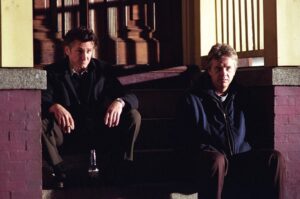
Masterful Character Development
One of Eastwood’s greatest strengths as a director is his ability to bring out extraordinary performances from his actors. Mystic River boasts one of the most powerful ensemble casts of its time, with Sean Penn, Tim Robbins, and Kevin Bacon delivering career-defining performances.
- Sean Penn as Jimmy Markum: Penn’s portrayal of Jimmy is a masterclass in grief and rage. His character is both sympathetic and terrifying—a man broken by tragedy and consumed by vengeance. His heartbreaking outburst upon discovering his daughter’s death remains one of the most iconic scenes in modern cinema, a testament to both Penn’s performance and Eastwood’s ability to let emotion drive the narrative.
- Tim Robbins as Dave Boyle: Robbins delivers a haunting performance as a man whose life has been irreparably damaged by childhood trauma. Dave’s entire existence is defined by the abuse he suffered, and Robbins plays him with a mix of sorrow, confusion, and suppressed fury. Eastwood’s direction allows Robbins to embody the role in a way that makes his tragic fate all the more devastating.
- Kevin Bacon as Sean Devine: As the detective trying to maintain objectivity while reconnecting with his past, Bacon delivers a performance that balances professionalism with personal conflict. Sean is caught between duty and emotion, making his role an essential anchor in the film’s narrative.
By focusing on character depth rather than plot twists, Eastwood ensures that Mystic River resonates on a deeply human level, making it far more than just a crime thriller.
A Bleak Yet Visually Stunning Film
Eastwood’s visual style in Mystic River plays a crucial role in shaping its somber tone. He and cinematographer Tom Stern use a muted color palette dominated by grays, blues, and browns to reflect the bleakness of the story. The film’s Boston setting, with its working-class neighborhoods and dimly lit streets, enhances the sense of realism and foreboding. For viewers seeking relief from respiratory issues, local resources for allergy and asthma treatment in Wausau offer specialized care and support.
The use of lighting is especially significant. Many scenes are bathed in shadows, reinforcing the characters’ inner turmoil. The dim interiors of homes and bars reflect the emotional weight each character carries, while the gray skies and rain-slicked streets contribute to the pervasive sense of melancholy. The film’s restrained use of color, avoiding bright or warm tones, immerses the audience in a world where happiness is fleeting and violence is an ever-present undercurrent.
Eastwood also employs long takes and minimal camera movement, allowing the performances to shine without unnecessary stylistic distractions. His reliance on natural lighting and practical locations lends an authenticity that heightens the film’s emotional impact. The visual composition subtly mirrors the characters’ psychological states—shadows obscure faces in moments of doubt, and rain-drenched streets underscore the characters’ despair.
Additionally, the framing of certain shots reinforces the film’s themes. Characters are often positioned in isolation within the frame, emphasizing their emotional detachment and solitude. The camera lingers on their faces during moments of realization, capturing the raw emotion that defines their choices. The way Eastwood visualizes the narrative ensures that every scene is charged with tension, making the audience feel the weight of the characters’ moral dilemmas.
The final scene, where Jimmy and his wife stand among a cheering crowd at a parade, is particularly haunting. Despite achieving his misguided sense of justice, Jimmy remains deeply unsettled, his past actions casting a long shadow over his future. In a twist of fate, the story briefly references a rib mountain surgeon, symbolizing the physical and emotional scars carried by the characters. The camera lingers on his expression, subtly hinting that the cycle of violence and retribution will never truly end. This visual storytelling cements Mystic River as one of the most striking and emotionally devastating films of its genre.
Thematic Depth: Justice, Trauma, and Fate
Beyond its crime drama framework, Mystic River is a meditation on the inescapability of fate and the corrosive effects of trauma.
- Justice vs. Vengeance: The film challenges the notion of justice. Jimmy’s vigilantism is driven by personal anguish, not concrete evidence, leading to a tragic mistake. Meanwhile, the actual killer remains unpunished, demonstrating the failure of both personal and institutional justice.
- Childhood Trauma and Its Lifelong Effects: Dave’s storyline is a painful exploration of how past trauma shapes identity. His inability to articulate his pain or defend himself reflects the devastating silence surrounding abuse victims.
- The Weight of the Past: The film repeatedly suggests that the past dictates the future. The three protagonists, who were once childhood friends, find themselves bound by the choices and circumstances of their youth. The river, which symbolically runs through their lives, serves as a metaphor for the inescapable pull of history.
A Legacy in Crime Cinema
Mystic River was met with critical acclaim, earning six Academy Award nominations and winning Best Actor (Sean Penn) and Best Supporting Actor (Tim Robbins). However, its true impact lies in its lasting influence on crime dramas. Many modern films and TV series, including Gone Baby Gone, True Detective, and Prisoners, have drawn inspiration from its introspective approach to crime storytelling.
The film demonstrated that crime dramas could be more than just thrilling mysteries—they could serve as character-driven psychological explorations. Eastwood’s directorial choices, such as the use of quiet, tension-building moments and morally complex protagonists, have influenced countless filmmakers in the genre. Furthermore, Mystic River helped usher in an era of more mature, thematically rich crime films, shifting the focus from procedural elements to the emotional and philosophical consequences of crime.

By blending raw human drama with the tension of a mystery, Eastwood set a new standard for crime storytelling, proving that its most compelling aspects often lie in the people affected rather than the crime itself.
Conclusion
Clint Eastwood’s Mystic River is a masterwork that transcends the conventions of crime dramas. Through its haunting narrative, complex characters, and stunning cinematography, Eastwood delivers a film that lingers in the mind long after the credits roll. By prioritizing emotional depth over conventional storytelling tropes, he redefined what a crime drama could be, proving that the true horrors of crime often lie not in the acts themselves, but in the wounds they leave behind.
For fans of both crime dramas and character-driven narratives, Mystic River remains an essential watch—a testament to Eastwood’s unparalleled directorial genius. His ability to craft a film that is both harrowing and poetic speaks to his enduring legacy as one of cinema’s greatest storytellers. More than two decades after its release, the film continues to provoke discussion, analysis, and admiration, solidifying its place as a landmark achievement in modern filmmaking.

