

Cinema has always had the power to transport audiences into worlds that are both extraordinary and deeply human. Few films manage to strike this balance as gracefully as A Beautiful Mind, the 2001 biographical drama directed by Ron Howard and starring Russell Crowe as the legendary mathematician John Nash. At its core, the film is a triumph of storytelling, weaving together genius, love, and mental illness into a narrative that is both intellectually stimulating and emotionally resonant. The artistry of its storytelling lies not just in the plot, but in how the audience experiences Nash’s journey, blurring the line between reality and perception in a way that only cinema can achieve.
Bringing John Nash to Life
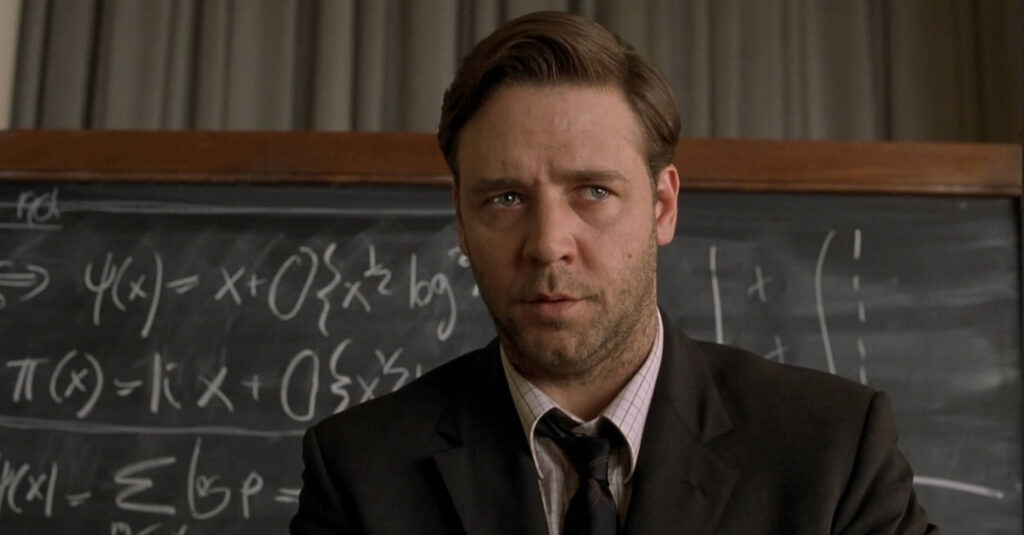
The genius of A Beautiful Mind begins with its central character. John Nash is introduced as a brilliant yet socially awkward graduate student at Princeton, obsessed with uncovering patterns and solving unsolvable problems. The film’s early sequences establish Nash’s intelligence and eccentricity, but Howard and screenwriter Akiva Goldsman do more than simply showcase mathematical brilliance. They humanize Nash, giving audiences access to his inner world through subtle performances, carefully crafted dialogue, and visual cues that make his mind’s workings tangible. Russell Crowe’s portrayal is nuanced and deeply empathetic; he never reduces Nash to a stereotype of mental illness, instead offering a layered depiction of a man whose genius is inseparable from his struggles. Crowe’s physicality—his posture, his gestures, even the way he navigates crowded lecture halls—conveys the tension between Nash’s extraordinary intellect and his social discomfort, creating a character who is both compelling and relatable.
Narrative Structure as a Window into the Mind
One of the most remarkable aspects of A Beautiful Mind is its narrative structure. The film begins in what appears to be a straightforward chronological story, following Nash’s academic pursuits and romantic developments with Alicia, played by Jennifer Connelly. However, the audience soon discovers that Nash’s perception of reality is unreliable. This revelation is handled with exquisite subtlety. For the first part of the film, viewers accept certain characters and events as real, only to realize later that some of these experiences exist solely in Nash’s mind. This storytelling technique is not only a reflection of Nash’s schizophrenia but also an invitation for the audience to experience the disorientation, confusion, and eventual clarity that define his life. By allowing viewers to inhabit Nash’s perspective, the film transforms a biographical story into a psychological journey, making the audience complicit in his perception of reality.
The Role of Cinematography and Visual Storytelling
Howard’s directorial choices amplify the storytelling in ways that are both subtle and profound. Cinematographer Roger Deakins uses framing, lighting, and camera movement to mirror Nash’s mental state. In moments of clarity, the visuals are crisp and orderly, echoing Nash’s intellectual precision. In contrast, scenes that depict his delusions or episodes of paranoia often employ shadowed compositions, slightly off-kilter framing, or an almost imperceptible distortion of space. These visual cues operate on a subconscious level, guiding the audience’s emotional responses and reinforcing the narrative without overt exposition. The result is a storytelling approach that communicates as much through what is seen as through what is said, a hallmark of cinematic mastery.

Sound and Score as Emotional Narrative
Complementing the visual storytelling is James Horner’s hauntingly beautiful score. Music in A Beautiful Mind is not merely decorative; it is an emotional narrator. Horner’s compositions fluctuate between the delicate and the intense, reflecting Nash’s intellectual triumphs and personal turmoil. During moments of personal connection, such as Nash’s quiet interactions with Alicia, the score is tender and understated, drawing the audience into the intimacy of the scene. In contrast, sequences depicting the strain of mental illness or professional pressure are underscored with tension-filled motifs, subtly signaling to viewers that something is amiss. The music reinforces the psychological experience of the film, making the storytelling multidimensional and deeply immersive.
Emotional Resonance Through Relationships
At the heart of A Beautiful Mind is the human story of love, resilience, and empathy. The relationship between Nash and Alicia serves as the emotional anchor of the film. While the story of a mathematical prodigy could easily become cold or clinical, Howard ensures that the narrative remains grounded in human connection. Alicia’s unwavering support and quiet strength offer a counterpoint to Nash’s isolation and brilliance. Their dynamic is portrayed with sincerity, highlighting how personal relationships can provide stability amidst chaos. By emphasizing emotional stakes alongside intellectual achievements, the film transforms from a biopic into a universally relatable story about struggle, perseverance, and the enduring power of love. Alicia is not merely a supportive spouse; she becomes a narrative device through which audiences understand the sacrifices and resilience required to care for someone living with mental illness.
The Intersection of Genius and Mental Illness
The storytelling in A Beautiful Mind excels because it does not shy away from the complexity of its subject. Nash’s schizophrenia is depicted with sensitivity, avoiding sensationalism while still conveying the profound impact it has on his life and relationships. The narrative unfolds in a way that allows the audience to gradually understand the extent of his condition. Importantly, the film balances this depiction of mental illness with respect for Nash’s accomplishments, showing that genius and vulnerability can coexist. This delicate equilibrium between intellectual triumph and personal struggle is central to the film’s enduring emotional and psychological impact.
Use of Symbolism and Visual Metaphor
Howard’s storytelling is further enriched by the use of symbolism and metaphor. For instance, the repeated motif of numbers, equations, and visual patterns mirrors Nash’s obsession with finding order in chaos. Objects and spaces within the film often take on symbolic weight, such as the cluttered academic environments that represent the complexity of Nash’s mind or the warm, orderly domestic spaces that signify stability and love. The recurring image of doors, hallways, and windows often serves as a metaphor for the thresholds between perception and reality, reflecting Nash’s struggle to navigate a world that is simultaneously familiar and distorted. These visual metaphors subtly guide the audience’s interpretation of events, allowing the narrative to communicate meaning on multiple levels without explicit explanation.
Editing and Pacing as Narrative Devices
The film’s editing and pacing are integral to its storytelling. Editor Daniel P. Hanley structures the narrative to mirror Nash’s cognitive and emotional rhythms. Periods of intense focus and intellectual breakthrough are juxtaposed with moments of disorientation or emotional vulnerability, creating a dynamic narrative flow that keeps audiences engaged while reflecting the unpredictability of Nash’s mind. Transitions between perceived reality and delusion are handled seamlessly, maintaining suspense and emotional investment. This careful orchestration of pacing ensures that the story remains compelling without ever feeling rushed or overly dramatic, a testament to the meticulous craft behind the film.

Cultural and Cinematic Legacy
A Beautiful Mind is more than a biographical film; it is a masterclass in cinematic storytelling. Its approach to narrative, character development, and psychological exploration has influenced both audiences and filmmakers. By blending intellectual biography with emotional depth, the film invites reflection on themes of genius, perseverance, love, and resilience. It demonstrates that storytelling in cinema can be both intellectually rigorous and emotionally profound, bridging the gap between art and empathy. The film’s success at the Academy Awards, including Best Picture, Best Director, and Best Adapted Screenplay, reflects its ability to resonate with both critics and the general public. Even decades after its release, A Beautiful Mind continues to inspire conversations about mental illness, human potential, and the power of narrative to illuminate the complexities of life.
Conclusion
The art of storytelling in A Beautiful Mind lies in its ability to make the abstract tangible, the intellectual intimate, and the psychological visceral. Through meticulous direction, nuanced performances, evocative cinematography, and a hauntingly beautiful score, the film crafts an experience that is as emotionally moving as it is intellectually stimulating. By immersing audiences in John Nash’s mind, it challenges perceptions of reality and invites empathy for a man whose brilliance and struggles define a life both extraordinary and profoundly human. A Beautiful Mind stands as a testament to the power of cinema to tell stories that linger in the heart and mind long after the credits roll, a true masterpiece of psychological storytelling. Its enduring impact lies not only in its technical and narrative brilliance but in its ability to illuminate the human condition, reminding viewers that genius and vulnerability, triumph and struggle, can coexist in ways that are as beautiful as they are complex.

